

Phantom Match
Gamee Global
Phantom Match is a puzzle game from Gamee Global that caught my attention because it puts a clear job in front of me: make matches, open a path, take the loot, and get away. That sounds simple, but the appeal comes from how those actions are connected. I am not only clearing a board for a score; I am trying to make each move serve a small heist plan. That extra purpose gives the familiar matching format a more focused feel.
I spent time with it as a quick-play mobile game rather than treating it like a long, story-heavy adventure. That is where it makes the most sense. A short session can feel complete, while a longer run gives me room to think more carefully about obstacles and the order in which I clear them. The key capability is turning every match into part of an escape plan, not merely another colorful move on a puzzle grid.
It is free to play and suitable for Everyone, which makes it easy to recommend for casual players who want a puzzle game without a complicated setup. The current version is 2.3, and it runs on Android from version 7.1 onward. The game has an average rating of 4.4 from around 11 thousand ratings, with over 100 thousand installs, so it has already found a noticeable audience without feeling like a game aimed only at dedicated puzzle specialists.
Why the heist objective changes the matching formula
Most match-style puzzle games train me to think about one immediate goal: create a combination, remove pieces, or reach a target score. Phantom Match adds a more practical question: what does this move allow me to do next? Clearing an obstacle may expose a route, create access to loot, or make the final escape easier. Even when the board looks familiar, the objective encourages me to read it as a small map rather than a collection of isolated tiles.
That distinction matters because it changes how I judge a good move. A large match is not automatically the best choice if it leaves the route blocked. I often prefer a modest clear that removes the obstacle in front of me, especially when it also opens space for a later combination. The game therefore rewards patience in a way that many quick matching titles do not. I have to balance immediate progress against the shape of the board that will remain afterward.
Related News






The robbery theme also gives ordinary puzzle actions a little more personality. Collecting loot feels like a concrete objective, while escaping gives the level a sense of direction. I am not simply tidying a board until the game says I have done enough. I am working toward a sequence with a beginning, a risky middle, and a finish. That framing is the reason I found the game more engaging than a completely abstract matching alternative.
At the same time, I would not describe it as a deep stealth game. The heist idea is expressed through puzzle decisions, not through a large simulation of guards, disguises, equipment, or open-ended routes. Anyone expecting a full robbery adventure should adjust expectations. The strength is the compact puzzle loop: match, clear, collect, and escape. It is focused, and that focus is also what keeps the game approachable.
Reading the board as a route
My most useful change in approach was to stop scanning only for the biggest available match. I first look at what is blocking the route and what will happen after that section opens. This small habit makes the game feel less random. I can usually identify a useful first action by asking whether it creates room, removes a stubborn obstruction, or brings the loot closer to a reachable path.
Gallery
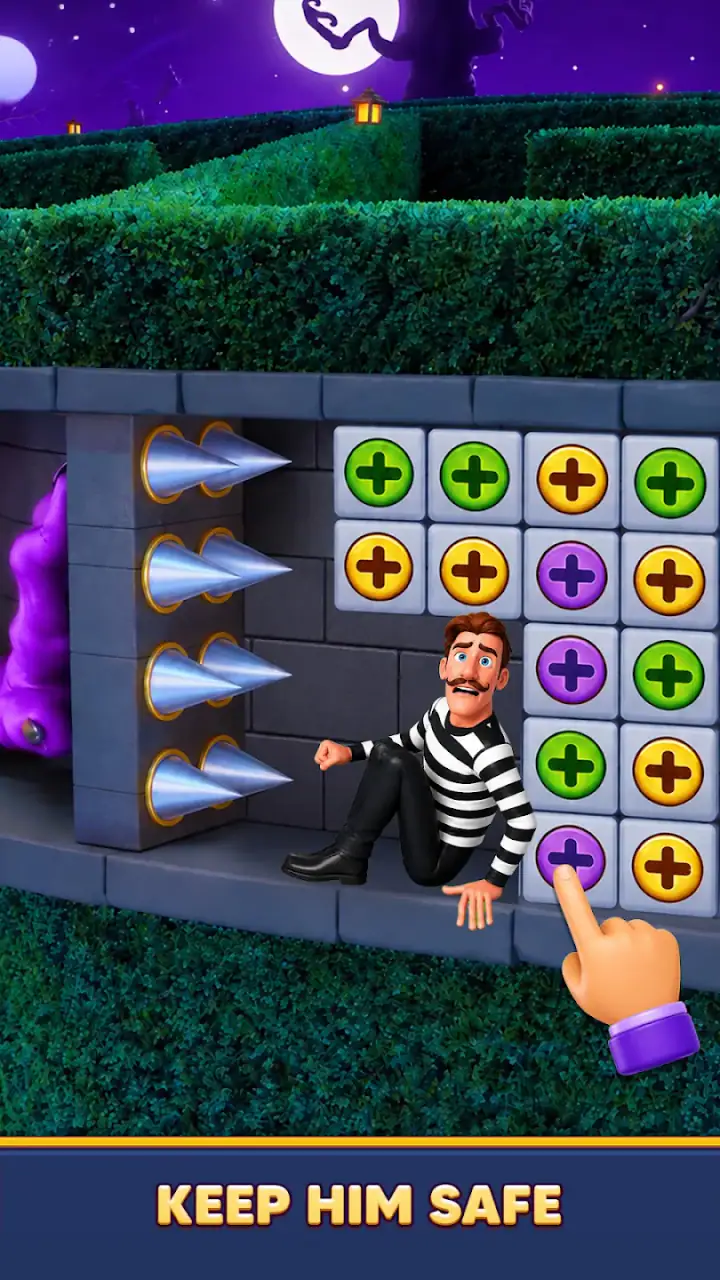
That does not mean every level becomes predictable. The board can still force me to choose between a safe short-term clear and a more ambitious setup. The interesting part is that both options may be reasonable, but they lead to different follow-up positions. I enjoy that kind of decision because it gives a simple touch-based game a little more mental texture without burying the player in rules.
One practical tip is to delay a tempting match when it sits beside a useful future route. Clearing too early can remove the pieces I was relying on to create a better opening. I also try to consider the escape before I commit to a collection move. If the loot is accessible but the exit remains awkward, I have not really solved the puzzle; I have only completed the attractive part.
This is one of the less obvious strengths of the game. The store summary presents the main actions, but it does not explain how much the order of those actions affects the experience. Players who treat every match as equally valuable may find the game frustrating. Players who think one or two moves ahead are more likely to see why the heist structure works.
How it feels in a normal play session
In practice, I find Phantom Match easiest to enjoy in short bursts. I can pick it up while waiting for a coffee, during a commute, or between larger tasks and immediately understand what I am trying to accomplish. The controls do not ask me to learn an elaborate interface before I can start solving. That low entry barrier is important for a puzzle game intended for broad age groups.
A typical session has a useful rhythm. I begin by checking the obstacles and the position of the loot, then search for a match that improves the route rather than merely producing a satisfying clear. Once a section opens, I reassess the board instead of blindly repeating the same pattern. Near the end, I become more conservative because the escape objective makes a careless final move feel more costly.
That rhythm also makes the game suitable for players who like a little planning but do not want a demanding brain-training product. I can play casually when I am tired, yet there is enough decision-making to reward attention when I am in the mood to solve carefully. The balance is not perfect for everyone: players who want constant action may find the planning slower than expected, while players who prefer elaborate logic puzzles may find the rules too light.
The free entry point is helpful. I can try the central loop without committing money first, which is exactly how I prefer to approach a casual puzzle game. There are in-app purchases ranging from $1.49 to $99.99 per item, so anyone who is sensitive to optional spending should keep that range in mind. I would personally treat purchases as something to avoid until I know whether the basic loop holds my attention over time.
A realistic everyday use case
Imagine having ten minutes before an appointment. I would open the game, play a few puzzles, and use the first attempt to understand the board rather than rushing for a flashy clear. If I fail to escape, the mistake is usually easy to identify: I opened the wrong route, spent a useful match too soon, or focused on the loot without preparing the exit. That makes a short session feel worthwhile even when the result is not perfect.
It also works well as a low-pressure break after work. I do not need to remember a long storyline or rebuild a complicated strategy from a previous session. The heist framing gives me an immediate purpose, and the matching mechanics let me settle into a familiar pattern. For this use, the game is more appealing than a competitive puzzle title that constantly pushes scores, rankings, or timed performance.
Parents looking for an accessible puzzle game may appreciate the Everyone content rating and the straightforward objective. I would still explain the purchase model before handing over a device, particularly if the player can access payment options. The game itself is easy to understand, but a simple interface does not automatically make spending decisions simple.
Tradeoffs, alternatives, and the players who benefit most
The biggest tradeoff is depth versus accessibility. Phantom Match gives the matching format a heist-shaped objective, but it does not try to become a full strategy game. That is good when I want a clean, focused diversion. It is less suitable when I am looking for extensive character development, a large world, or a puzzle system with many interacting rules.
Compared with a standard match-three game built mainly around score and progression, this one gives my moves a clearer practical purpose. I am more likely to consider the board layout and the order of actions. Compared with a pure logic puzzle, though, it feels more forgiving and more immediately visual. I do not get the same satisfaction as solving a complex deduction problem, but I also do not face the same learning curve.
Compared with an endless arcade puzzle, the escape objective gives sessions a better sense of closure. I can finish a heist and put the phone down rather than feeling that I have stopped in the middle of an ongoing score chase. The tradeoff is that the objective may feel repetitive if the basic sequence of matching, collecting, and escaping does not continue to offer enough variation for a particular player.
Another limitation is that the central idea can make mistakes feel more annoying than they would in an abstract game. When I lose a promising route because I made a poor match, I understand why it happened, but I may also feel that the board has become unrecoverable. Players who dislike restarting or adjusting a plan after one bad decision may prefer a more relaxed matching game.
I also would not choose it as my first option for social competition. Its appeal, at least in my experience, comes from the private satisfaction of reading a board and completing a compact objective. If your priority is direct multiplayer interaction, a competitive puzzle alternative will probably be a better fit. Phantom Match is strongest when I want to solve something at my own pace.
Small habits that improve the experience
My first recommendation is to inspect the exit before collecting the most obvious loot. The reward attracts attention, but the escape is what completes the task. Planning backward from the finish helps prevent a common mistake: spending the only convenient clearing opportunity on the middle of the board and leaving the final route awkward.
Second, I try to preserve flexibility early in a puzzle. A match that opens several possible follow-ups is often more valuable than one that clears a narrow area but leaves no useful arrangement. This is especially helpful when the board contains multiple obstacles. I would rather create room to reassess than lock myself into a single line too soon.
Third, I separate “progress” from “visual satisfaction.” A large clear can look like the best move, but the correct choice may be the quieter one that removes a specific barrier. This is the kind of distinction that makes the game more rewarding after the first few sessions. It also gives experienced matching-game players a reason not to rely entirely on habits learned elsewhere.
Finally, I recommend setting a personal spending boundary before using the free version for a longer period. The lowest listed purchase is $1.49, while the highest reaches $99.99 per item. I do not see that as a reason to reject the game outright, but it is a meaningful consideration for families and for anyone who prefers games with no purchase pressure. Trying the core loop first is the sensible approach.
Who should install it and who should skip it
I think Phantom Match is a good choice for casual puzzle players who enjoy matching mechanics but want more direction than “clear as much as possible.” It is especially appealing if you like planning a route, making a few deliberate choices, and finishing a self-contained objective. The Everyone rating also makes it broadly approachable, provided the person playing understands the optional purchase environment.
It is a particularly good fit for short breaks because the heist structure gives each session a clear reason to begin and end. I can play attentively for a few minutes without needing a long uninterrupted block. The game also suits people who enjoy learning through trial and error: a failed escape usually teaches me to reconsider the order of my next moves rather than simply telling me that I need faster reactions.
I would skip it if I wanted a substantial narrative, a realistic stealth experience, or a puzzle game built around difficult deduction. I would also look elsewhere if I strongly dislike free-to-play purchase ranges or prefer a single upfront price. The game’s central concept is focused enough that its limitations are easy to see; it does not pretend to serve every kind of mobile player.
Gamee Global has made a compact puzzle experience with a useful twist rather than adding a complicated theme on top of familiar mechanics. The robbery framing genuinely affects how I play because it makes route planning, obstacle clearing, loot collection, and escape feel connected. It is not a revolutionary puzzle system, but it is more purposeful than a basic matching board.
My final recommendation is positive, with sensible expectations. Phantom Match is best when you want a quick, approachable puzzle heist that rewards thinking one move beyond the obvious. Try the free version, pay attention to the route instead of chasing every large match, and decide for yourself whether the repeated escape loop stays interesting. For me, that focused capability is enough to make it worth keeping on a casual gaming rotation.
FAQs for Phantom Match
What is Phantom Match, and how does the game work?
Phantom Match is a match-3 puzzle game built around mysterious, supernatural-themed environments. Players usually progress by matching identical symbols, completing level objectives, and using special boosters to clear difficult board layouts. As you advance, the game introduces new challenges, visual settings, and mechanics. Its short levels make it suitable for casual play, although later stages may require more planning and careful use of power-ups.
Can Phantom Match be played offline?
Phantom Match may allow some puzzle levels to be played without a continuous internet connection, which is useful when traveling or when mobile data is unavailable. However, an internet connection can still be required for downloading the game, synchronizing progress, receiving updates, viewing advertisements, accessing events, or using online features. Availability can vary by version and device, so it is best to test offline access after installation.
Is Phantom Match free to download and play?
Phantom Match is generally offered as a free download, allowing users to begin playing without paying an upfront purchase price. Like many mobile puzzle games, it may include optional in-app purchases for coins, lives, boosters, or other advantages. Advertisements may also appear between levels or during reward offers. You can normally progress without spending money, but patience may be needed when energy or attempts are limited.
Does Phantom Match contain advertisements or in-app purchases?
Yes, players should expect that Phantom Match can include advertising and optional purchases, depending on the platform and current release. Ads may provide extra rewards, additional moves, or temporary bonuses, while purchases can speed up progress or replenish resources. Before downloading, review the store listing and your device’s purchase settings, especially if children will be using the game or if accidental spending is a concern.
What devices are compatible with Phantom Match, and is progress saved?
Compatibility depends on the specific Android or iOS version, the device’s operating system, available storage, and the requirements listed in the official app store. A stable connection may also be needed for updates and account synchronization. Progress-saving options can differ between releases; some versions may use a platform account or cloud backup, while others primarily store progress locally. Check the in-game settings before changing devices or reinstalling.
Pros
- Quick
- easy-to-learn matching gameplay for short play sessions.
- Mystery-themed presentation gives the puzzles a distinctive atmosphere.
- Progression gradually introduces more challenging matching situations.
- Offline play may be convenient when you have limited internet access.
- Simple controls make it accessible for casual players of most ages.
Cons
- Repeated matching tasks can become monotonous after extended play.
- Later levels may feel more dependent on trial and error.
- Hints or extra moves may be limited unless you watch ads or spend currency.
- Visual effects and animations can make some screens feel busy.
- The game may offer less long-term depth for experienced puzzle players.


